Strategic communication support for managers on collaborative projects
The Context: A paradigm shift
Engineering projects are no longer delivered the way they used to be. With the evolution of project delivery methods (driven in particular by Bill 62 in Quebec), the industry is shifting toward collaborative models.
In these new environments, your teams work alongside partners, sometimes competitors, and subcontractors. Decisions are no longer made in silos, but within shared committees. In other words: you no longer fully control your environment, yet you remain accountable for the outcome. The performance of your projects no longer relies solely on your technical expertise, but directly on the quality of your leaders’ interactions.
The Challenge: The Engineering of Human Relations
Your managers are solid; they know how to deliver, analyze, and optimize. However, collaborative projects require a different skill set. They must now:
- Influence without direct hierarchical authority.
- Navigate complex and tense inter-firm dynamics involving financial stakes.
- Take a stand and defend your interests without bringing discussions to a standstill.
The majority of engineering managers were trained to analyze and make decisions, but rarely to influence in this type of context. The result? It is not the collaborative structures that fail; it is the unprepared human dynamics. Exchanges become complicated, positions become defensive, and collaboration weakens.
The Cost of Inaction : Invisible Friction
In a collaborative environment, every inefficient interaction becomes a hidden cost. These behavioral issues quickly translate into severe operational impacts:
- Slowing down or stalling of decision-making processes.
- Unaddressed tensions that accumulate between partners.
- Energy wasted managing conflicts instead of moving the project forward.
Less relational fluidity always equates to delays, increased complexity, and weakened profitability.
Our Solution : Preparing Leaders for Collaborative Challenges
We intervene where few others position themselves: we secure the human performance of your engineering managers in collaborative projects. We don’t do theory. Our mandate is to practically prepare your leaders to maintain a stable posture under pressure, to prevent technical exchanges from turning into confrontations, and to contribute to fluid collective decisions.
Our Approach : A 4-Phase Methodology
Our intervention is structured, measurable, and directly tied to the context of your projects:
- Phase 1 — Analysis of the individuals involved (Pre-project): Assessment of leadership dynamics (TRIMA + Impact Index) to identify blind spots, reactivity under pressure, and relational risks among your managers.
Deliverable: A report on the strengths and challenges of the leader(s) involved, along with recommendations and tools for developing strategic communication skills. - Phase 2 — Preparation (Project launch): Equipping teams with strategic communication tools. We work on the posture of influence without formal authority and on taking a stand during critical exchanges.
Result: Intentional, less reactive, and more influential interactions. - Phase 3 — Simulation (Key moments): Preparation for high-risk situations through simulations of collaborative committees, technical disagreements, and role-playing based on real scenarios, followed by strategic debriefings.
Result: Informed managers who are acutely aware of the challenges inherent in collaborative environments. - Phase 4 — Stabilization (During the project): Individual support in real-world contexts. “Red phone” access to prepare for high-tension meetings, quickly adjust interaction strategies, and debrief critical moments.
Result: Reduced friction, sustained operational fluidity, and continuous support.
Our Differentiators
- Specialization: Expertise dedicated specifically to the realities of engineering managers.
- Pragmatism: An intervention focused on real behaviors under pressure, far from abstract concepts.
- Hybrid Methodology: The unique integration of influential positive leadership (mastering reactivity) and strategic influential communication.
Next Steps
Collaborative projects rely on your managers’ ability to collaborate effectively when the stakes are high. Where do your teams stand today in the face of these new contexts?
We propose an exploratory meeting to:
- Clarify the specific friction points in your current projects.
- Identify the manager profiles that need priority support.
- Define a targeted intervention architecture (individual coaching or project team support).
Positive Leadership Activation — We support engineering managers in their pivotal moments — where the pressure rises and leadership must elevate.
With Bill 62, public bodies now have a legal framework allowing them to integrate a collaborative approach directly into the contract awarding processes. The law explicitly states that this approach can include bilateral workshops in the presence of a process auditor, structured discussions with shortlisted competitors, the pooling of resources and information, as well as the sharing of risks and rewards.
In concrete terms, this means that firms will no longer be evaluated solely on their price or technical capacity, but also on their current ability to collaborate in complex and interdependent contexts.
In many collaborative calls for proposals, workshops are becoming spaces where project owners directly observe:
- The quality of interactions
- The ability to resolve tensions
- Listening skills and transparency
- The posture of the leaders
- The fluidity of exchanges
- The teams’ ability to work with partners they do not manage
This evolution creates a new strategic challenge for engineering firms: preparing their leaders to be evaluated not only on their technical know-how, but on how they interact, influence, and collaborate under pressure.
At Positive Leadership Activation, we support organizations in this now-critical preparation through collaborative workshop simulations, strategic communication tools, relational assessments (such as TRIMA and team sociograms), as well as targeted work on leadership, tension management, and the quality of interactions within consortiums and collaborative projects.
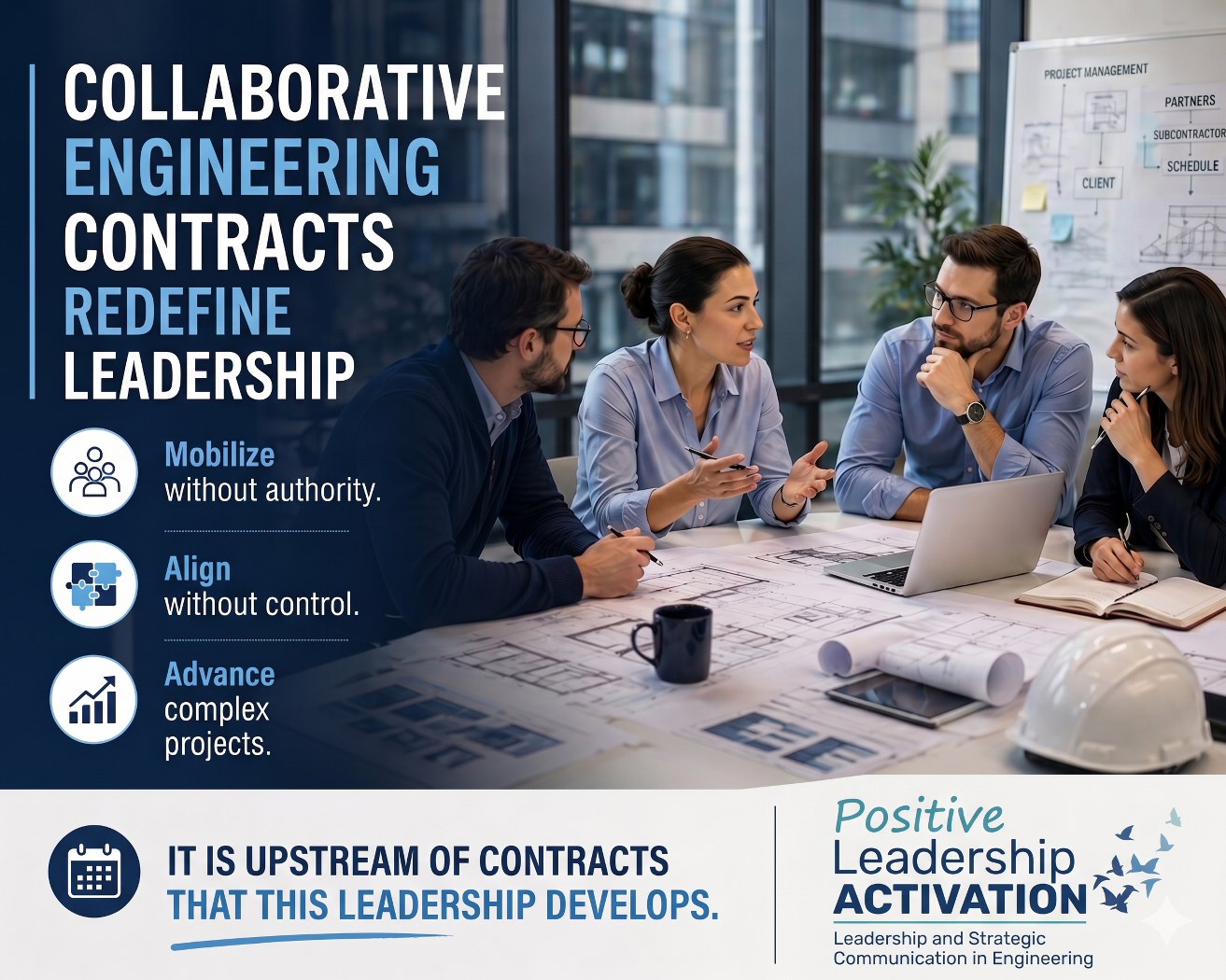
Bill 62 isn’t just about building better — it’s about collaborating differently
Winning collaborative proposals begins here.
Schedule your free 30-minute call today
with Lyne Marie Germain, CPQC